Search Invasive Species

Take Action Maps Where to Get Help Report a Sighting

Or call DEC directly at 1 (866) 640-0652


EAB News

  • May 10, 2013. "EA Village Considers Tree Matters" - Local news article from East Aurora, NY more »
  • May 10, 2013.   2014 U.S. Forest Service National Urban and Community Forestry Challenge Cost-Share Grant Program   more »
  • April 8, 2013. Invasive Emerald Ash Borer Found in New Hampshire more »

EAB Events

No news entry at the moment


EAB FACTOIDS

Less than 1% of New York's Forests are Infested with EAB. Plan Now.

The Emerald Ash Borer puts all of New York's 900 MILLION ash trees at risk.

Black and Green Ash are keystone species in wetland ecosystems- their loss could mean the loss of a whole ecosystem.

In New York State's hardwood forests 1 in every 10 trees is an ash.

Emerald Ash Borer (Agrilus planipennis)
photo

photo

photo

photo

photo

photo


EAB HOME PAGE

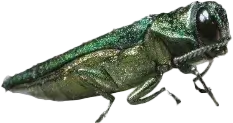
The Emerald Ash Borer, Agrilus planipennis Fairmaire (Coleoptera: Buprestidae), commonly referred to as "EAB", is an invasive wood-boring beetle. Native to Asia, the beetle's first North American populations were confirmed in the summer of 2002 in southeast Michigan and in Windsor, Ontario. EAB was likely introduced to the area in the mid-1990's in ash wood used for shipping pallets and packing materials in cargo ships or shipping containers. Emerald Ash Borers feed on and eventually kill all native ash trees (Fraxinus spp.). Slowing their spread is imperative.


EAB Infestations and Quarantined Areas in NY

Since its introduction into North America, 18 states (Connecticut, Illinois, Indiana, Iowa, Kentucky, Kansas, Maryland, Massachusetts, Michigan, Minnesota, Missouri, New York, Ohio, Pennsylvania, Tennessee, Virginia, West Virginia and Wisconsin) and two Canadian provinces; Ontario and Quebec. EAB was first confirmed in New York in June 2009 near Randolph, in western Cattaraugus County.

The natural spread of EAB infestations in North America is about 2 miles per year, depending on the infestation intensity. However, the rapid spread of the beetle through North America is most likely due to the transport of infested firewood, ash nursery stock, unprocessed ash logs, and other ash products. In an effort to slow the continued spread of EAB, both Federal and State agencies have instituted quarantines of infested areas to regulate the transport of ash products. Click here to read about the NYS quarantine.